Project
Three years of identity, development and relations for an extended research partnership on food sustainability
OnFoods: the national recovery plan partnership on food sustainability
- Client
- OnFoods Foundation
- Area
- Identity, Development
- Year
- 2023-2026
- Main link
- Go to the website
Research communication almost always comes afterwards. First the science is done, then, if time and budget remain, it gets told. For a partnership bringing together 26 organisations and hundreds of projects that order does not hold. Without a shared account, the network stays a sum of acronyms.
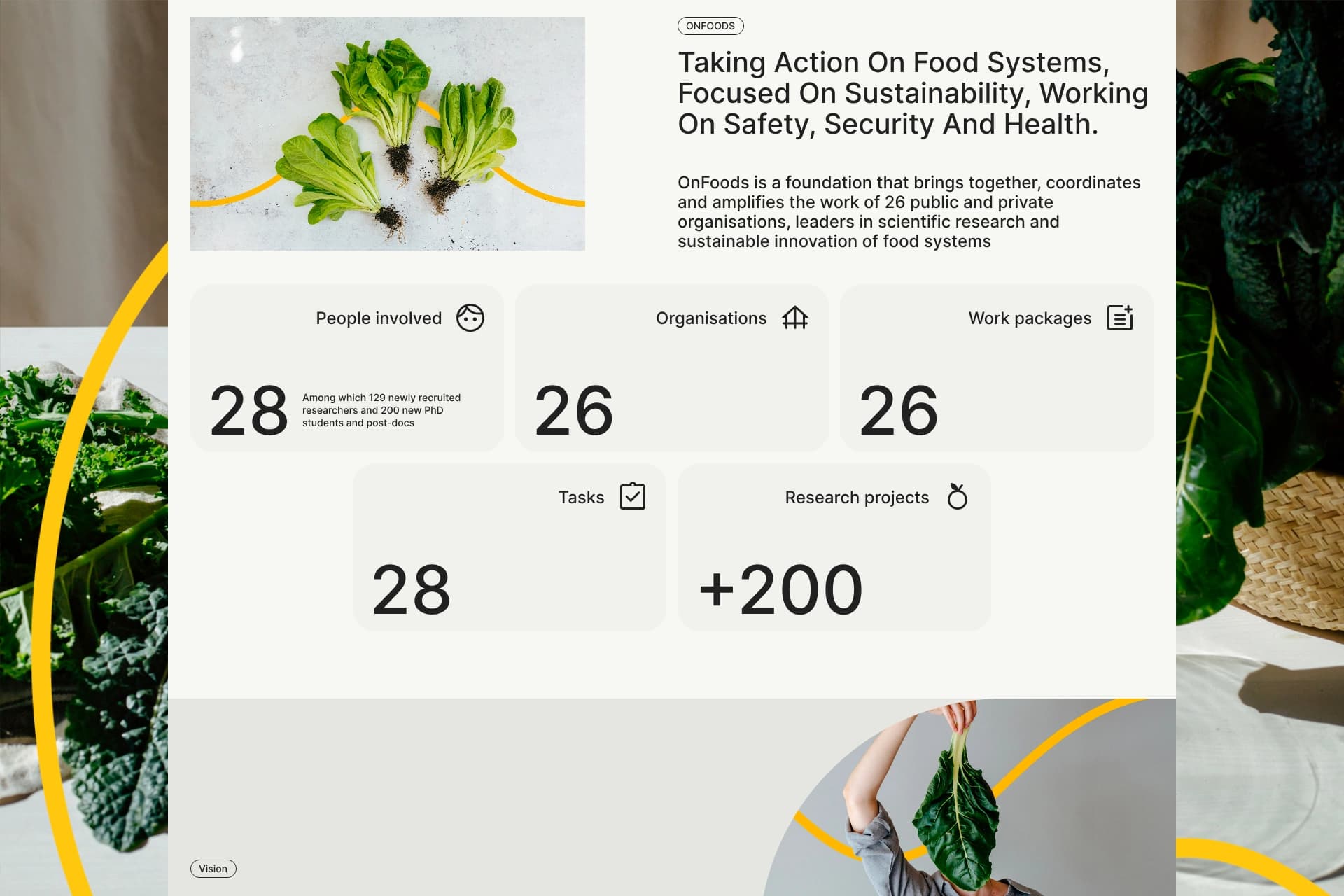
OnFoods is a foundation bringing together 26 public and private organisations, among them universities, research centres and food companies, on the sustainability, accessibility and safety of food and nutrition. It was selected as one of the fourteen extended partnerships of the national recovery plan funded by the Ministry of University and Research in the area "Models for sustainable food", with 114.5 million euro and the University of Parma as lead partner.
In three years it has incubated over 350 research projects and involved more than 150 companies in the agri-food sector, organised along seven thematic lines, the Spokes. Since 2023 Dinamo has supported its identity, its platform and its voice.
An umbrella brand, a matrix web platform and an editorial presence that never stopped.
Brand strategy and identity
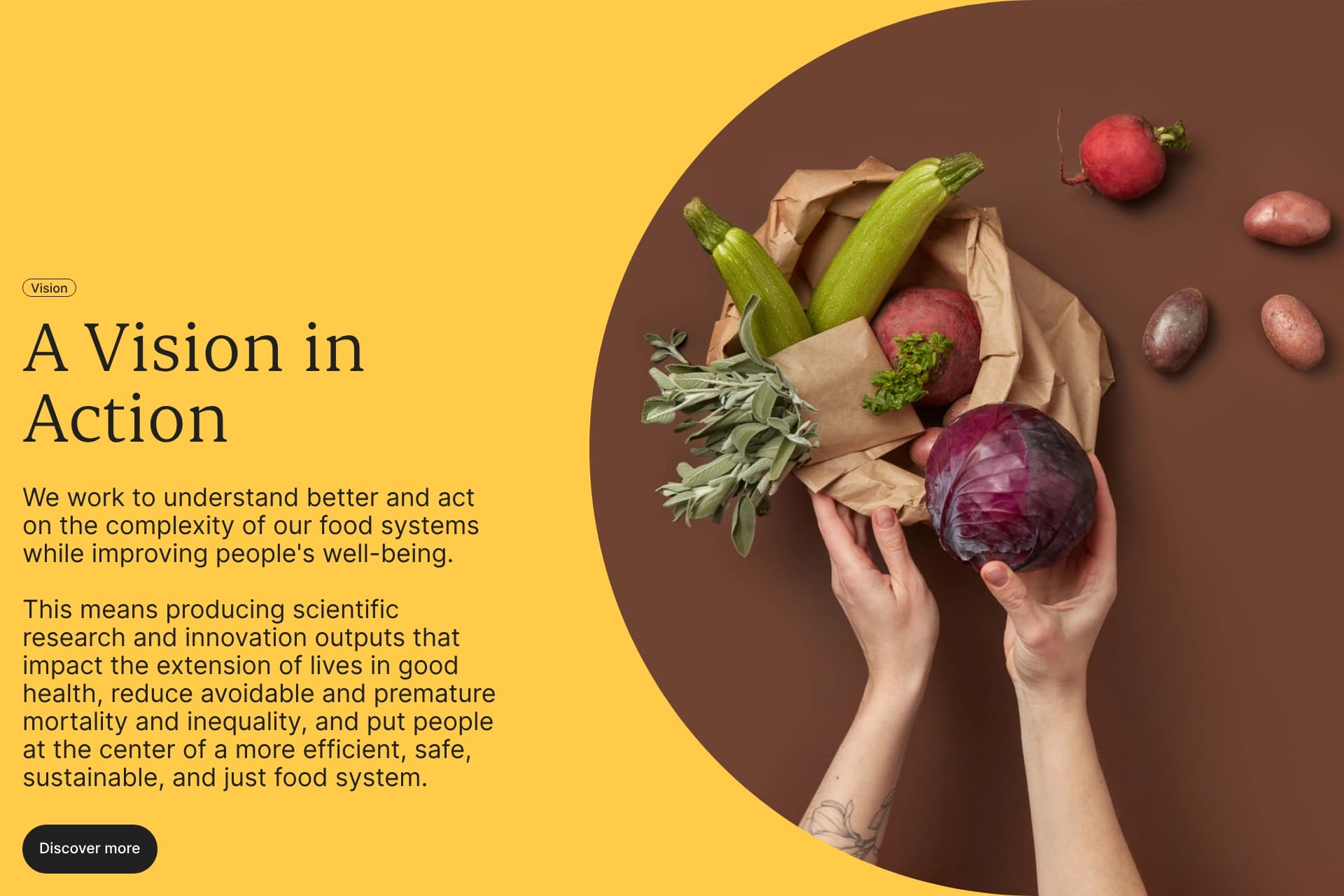
The work began with a series of brand strategy workshops with the Foundation's staff: brand heart (purpose, vision, mission, values), brand messaging and visual identity. OnFoods is an umbrella brand. A single promise, the hub, gathering projects very different from one another, the Spokes. The strategy was built on several levels, with an open, scalable visual language designed to carry three years of activity, dozens of sub-projects, hundreds of events and a research community in continuous growth.
The website: a matrix organisation of information
Most websites of extended recovery plan partnerships adopt a linear information architecture: a Governance section, a Spoke section, a News section, a Funding calls section. The user scrolls flat lists and rarely finds content related to their own Spoke or their own theme. The site becomes a shop window for the structure of the project, not a tool for consultation.
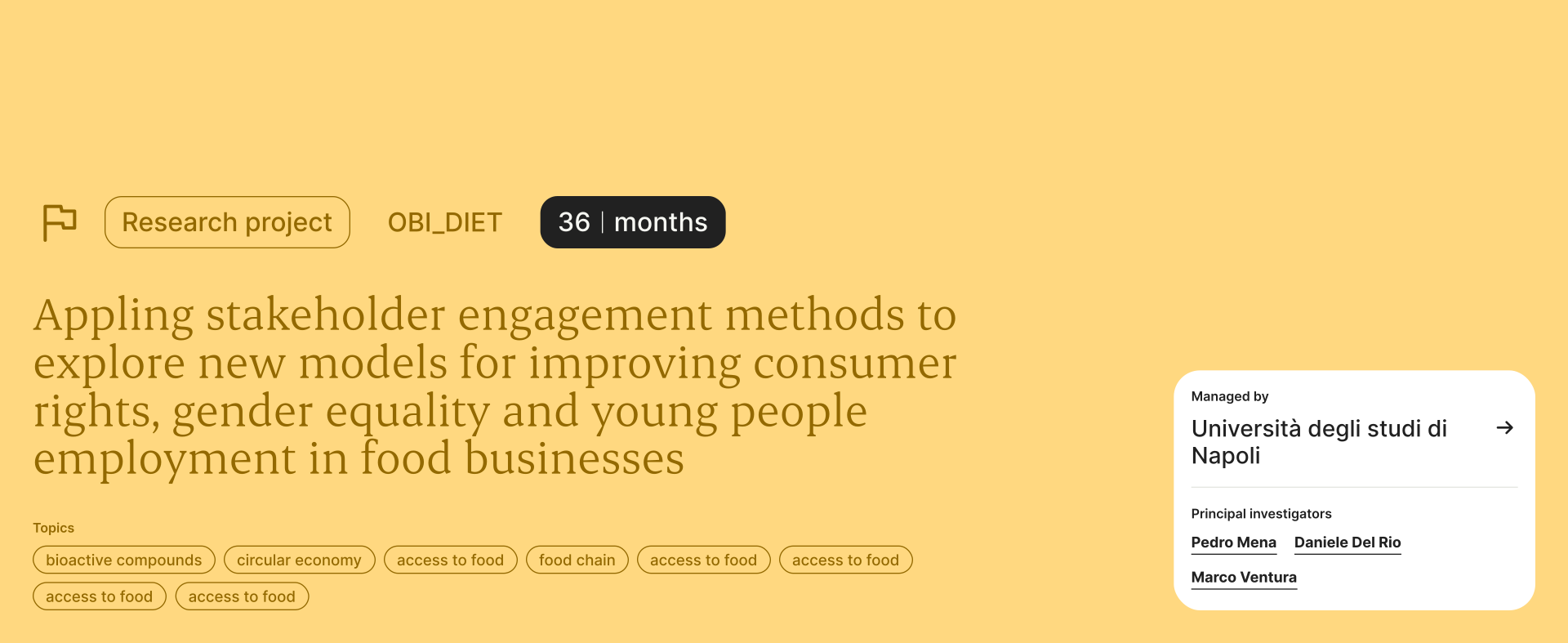
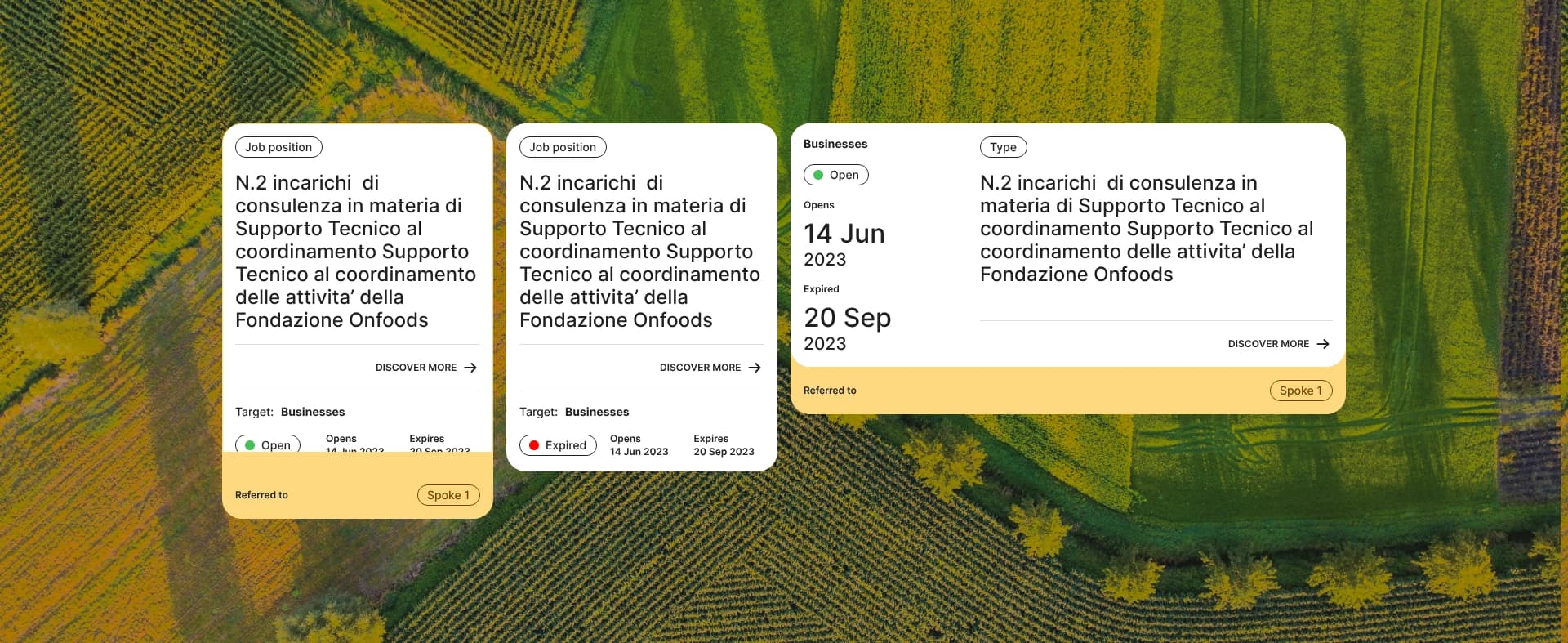
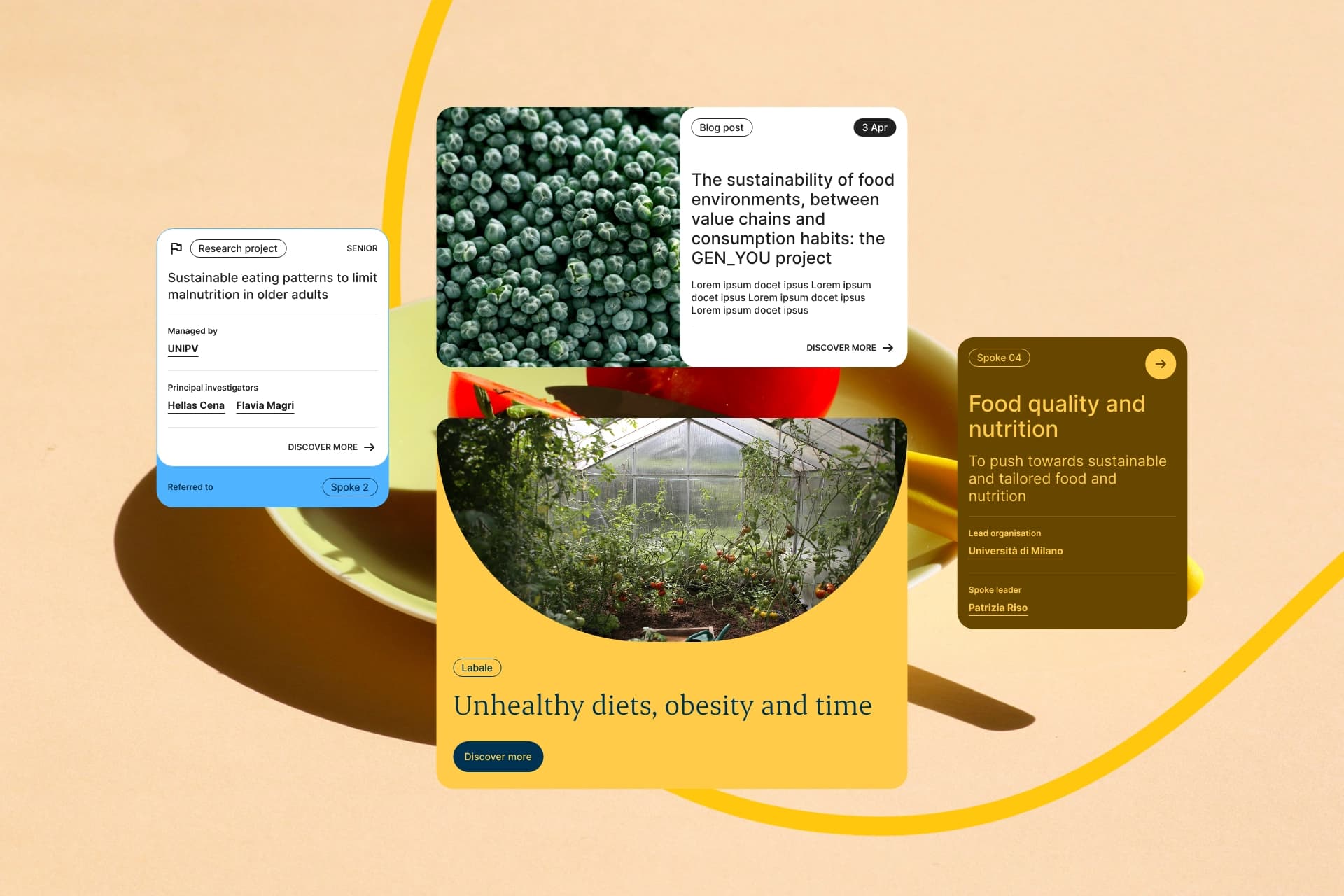
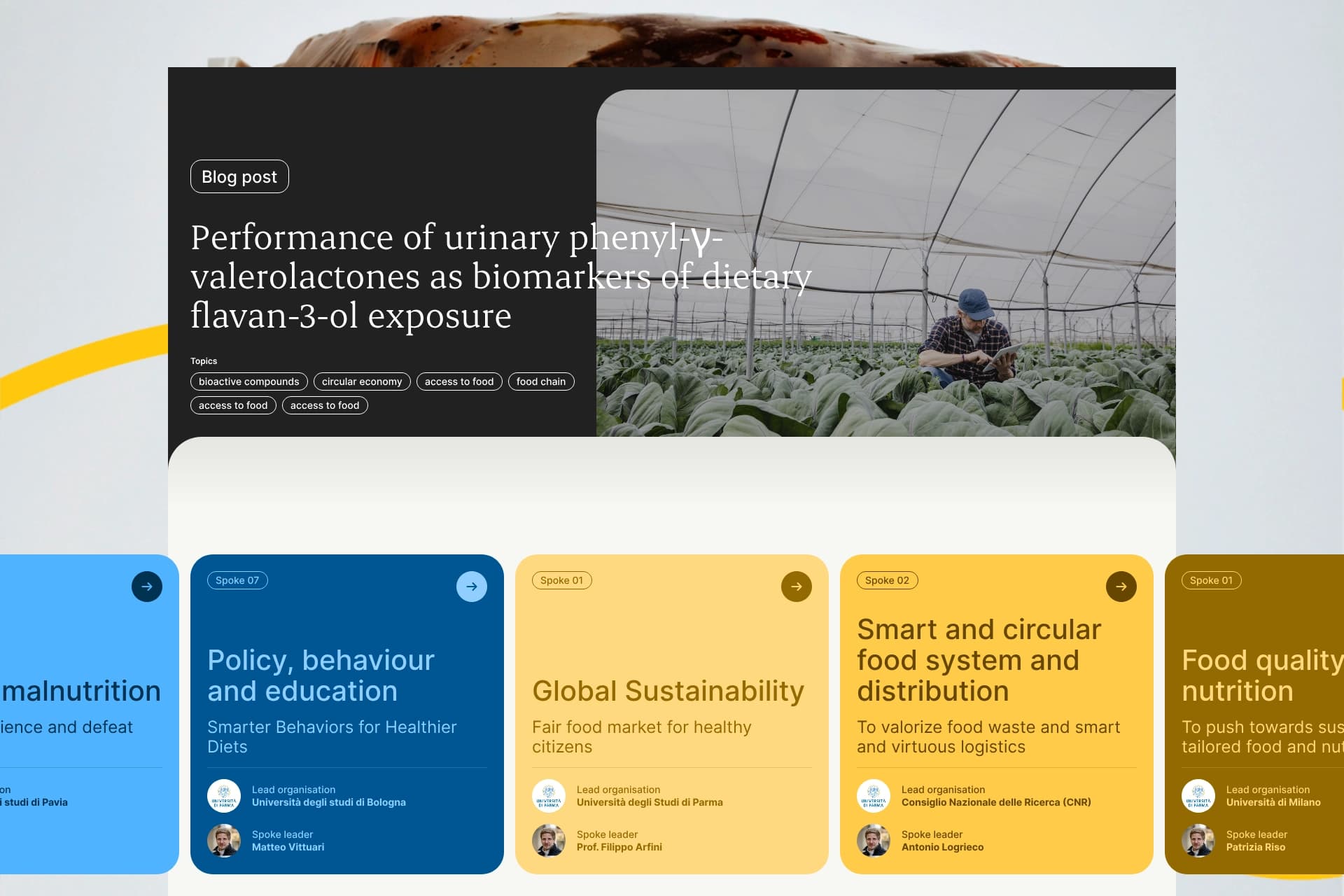
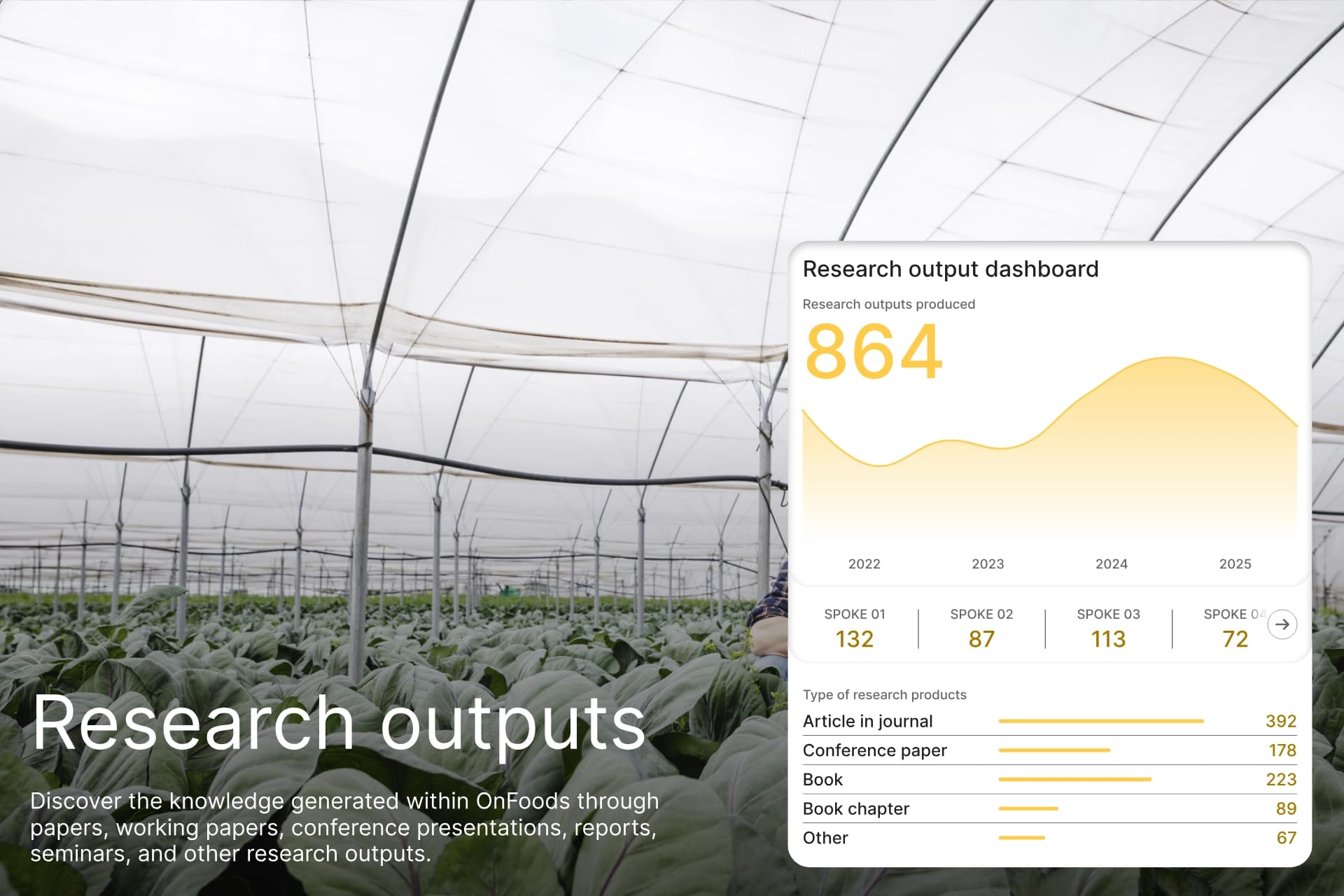
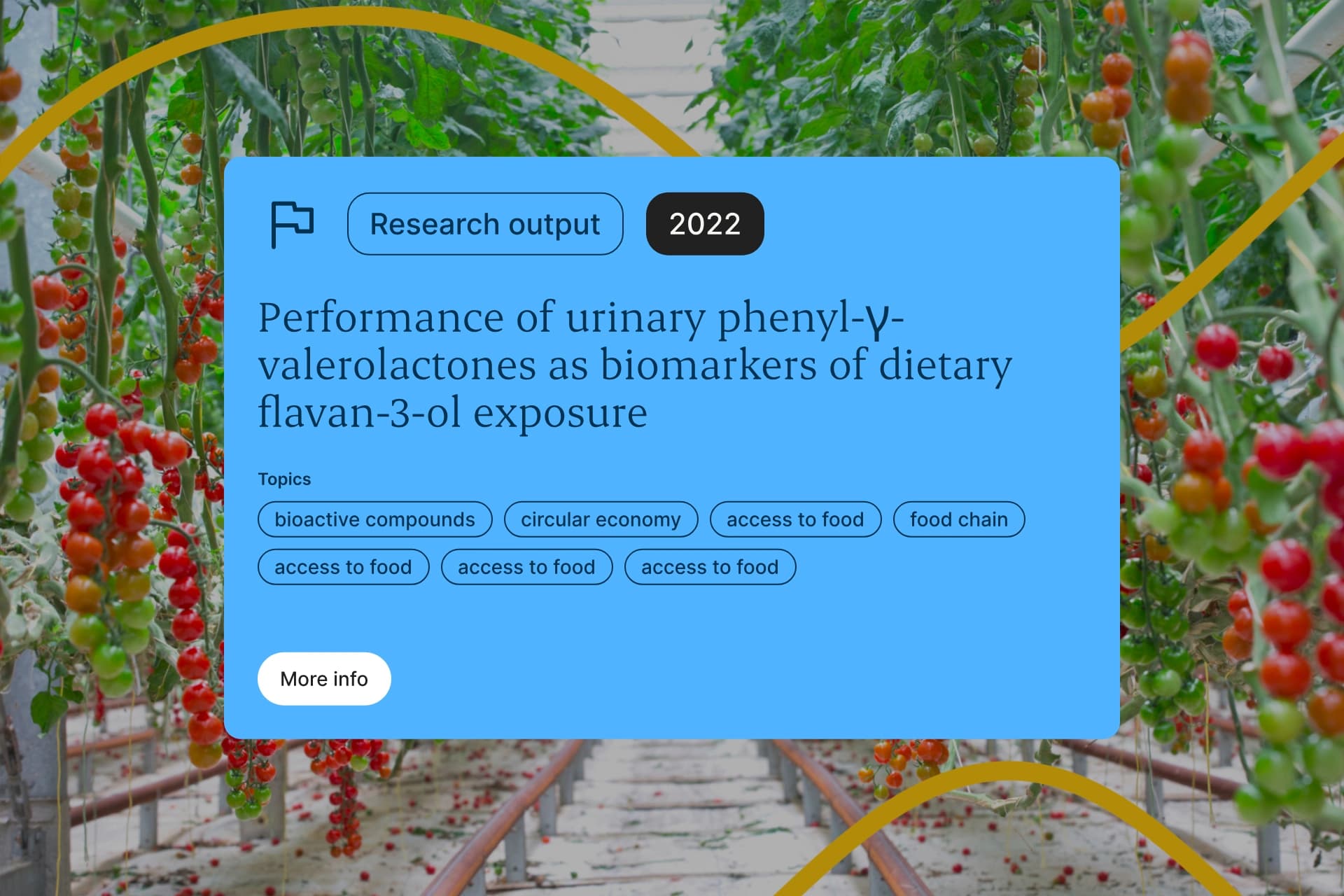
For OnFoods we chose a different approach. The site's six main areas, About, Spoke, Research Projects, Research Outputs, Opportunities and Magazine, are six views of the same dataset. Every project is linked to its Spoke and its work packages. Every research output carries the relevant Spokes. Every Magazine article is tagged with the Spoke it covers. Every event refers to the network of organisations involved.
Whoever enters from a Spoke finds its projects, its outputs and its articles. Whoever enters from the Magazine reaches the Spoke and from there the whole body of work. Whoever searches by theme crosses research, public engagement, events and funding calls as parts of the same story. It is a navigable matrix, not a sum of silos. Adding a new open access paper or a new event means updating one record that then appears automatically in the relevant views, with no editorial duplication.
Technology stack
The stack was designed to carry the complexity and to last: a React PWA frontend, headless Drupal 10 as the source of truth, Elastic Search for cross-cutting search over the whole dataset, REST APIs in Node.js mediating between CMS and frontend, a microservice architecture, a modular page builder for the editorial team and advanced permission management for the different profiles working on content.
The editorial presence: three years of continuous voice
The site launched on 16 May 2023 with eight long-form pieces presenting the project, the Spokes and the research themes, in a narrative register able to make complex questions of nutrition and sustainability accessible.
Since then the Magazine has grown continuously, structured across different editorial formats, from Features to News, Event, Interview and Report, and written by an in-house editorial team that brings together science writers, communication managers, journalists and researchers from the partnership. It is a marked distance from the sector average, where partnership communication is exhausted in administrative news and announcements of funding calls.
In three years the voice of OnFoods has accompanied international events (HACKonFOODS, symposia, congresses), partnerships across the supply chain (BITE, Barilla Innovation & Technology Experience, Cibus Tec Forum, ReRITT, TuttoFood Milano) and the opening of the research to the public in a carefully judged register. The editorial close of the programme is entrusted to the volume Handbook OnFoods, a map of three years of shared work that sets research, industry and public policy in relation to one another.